Atlassian Migrations — The Deadline Nobody's Watching (It Isn't 2029)
Mihai Perdum
Author
7 min readJuly 3, 2026
At the end of my last post I said there was a second migration hiding behind the first one — that the platform you're racing to isn't quite the finish line either. A few people asked me what I meant. This is what I meant.
Everyone in the Atlassian world is staring at one date. March 2029. Data Center end of life. It's on every roadmap, every board deck, every anxious Slack thread. And it should be — it's real, and it's big.
But it's years away. And while everyone's looking at it, there's a second Atlassian deadline that lands at the end of 2026 — sooner, quieter, and sitting directly underneath the apps you already spent a fortune moving to Cloud.
Two of its three phases have already passed. Almost nobody I talk to knows it exists.
Your apps didn't move to Cloud. They moved onto Connect.
Your issues and pages moved to Cloud. But the third-party apps you rely on — the time trackers, the diagramming tools, the SLA reporters, the ScriptRunner-shaped things — didn't just move to Cloud as one clean idea. They moved onto a specific framework called Atlassian Connect. It's the plumbing a large share of Cloud Marketplace apps are built on. You never see it. You were never supposed to.
And Atlassian is retiring it.
Not "encouraging people off it." Not "recommending a modern alternative." Retiring it, on a fixed, published timeline they announced back in March 2025, with concrete enforcement dates and a named successor. The successor is Forge — and I'll come back to Forge, because the one thing you can't afford is to confuse the two.
The countdown that's already two-thirds done
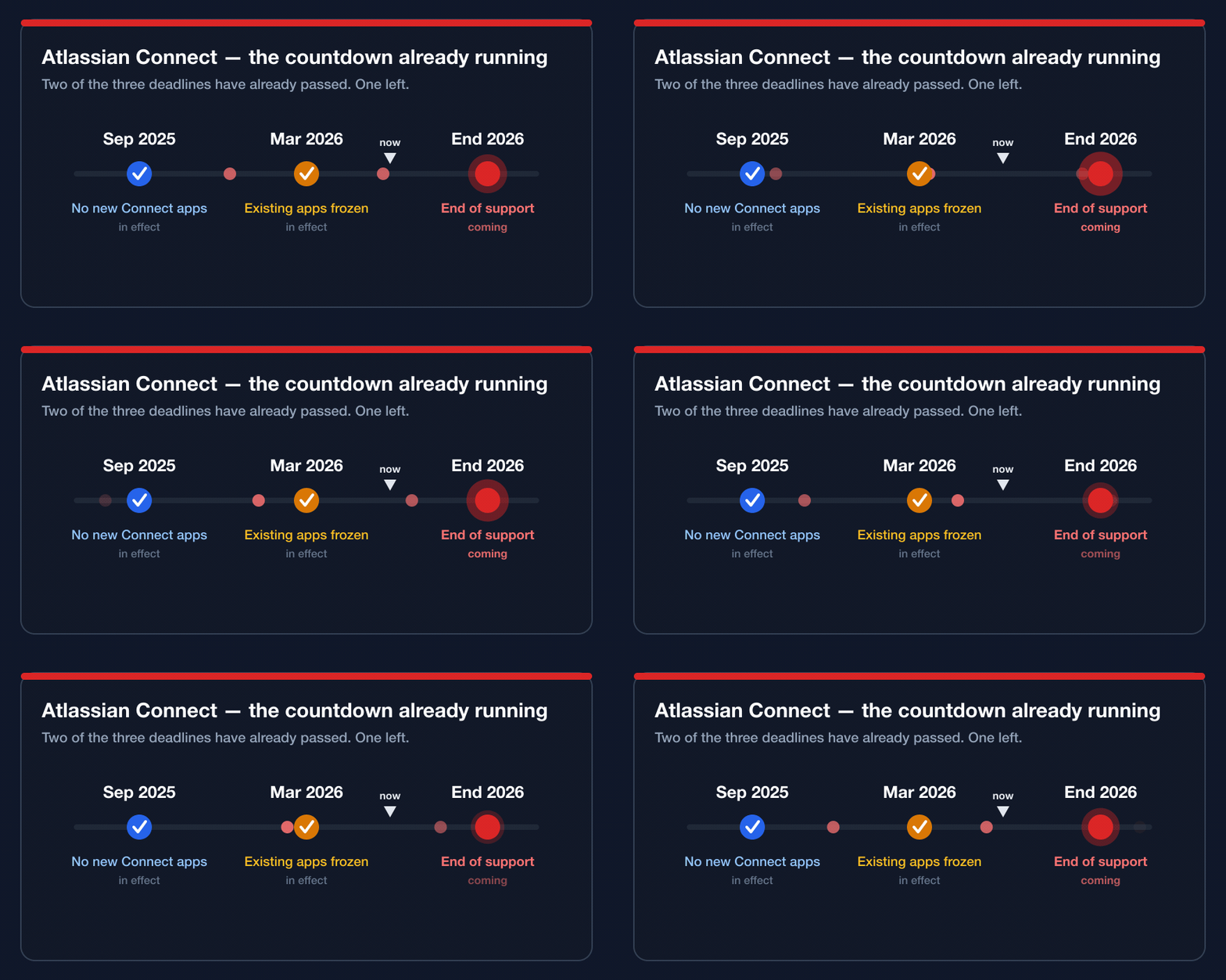
Atlassian's own three-phase Connect end-of-support timeline. As of now, only the last phase is still ahead.
Phase one hit on 17 September 2025. From that date, no new Connect app can be listed on the Marketplace at all — Atlassian's words are that any new Cloud app "must be created on Forge and may not contain any Connect modules." That door is already shut. It's been shut for the better part of a year.
Phase two hits on 31 March 2026. From that date, existing Connect apps are frozen — vendors can no longer push the updates that add new features, scopes, or permissions. By the time you're reading this, that one has almost certainly landed too.
Phase three is the one still ahead: the end of 2026, when Connect reaches full end of support. And that's the phase everyone will misunderstand.
What "frozen" actually means
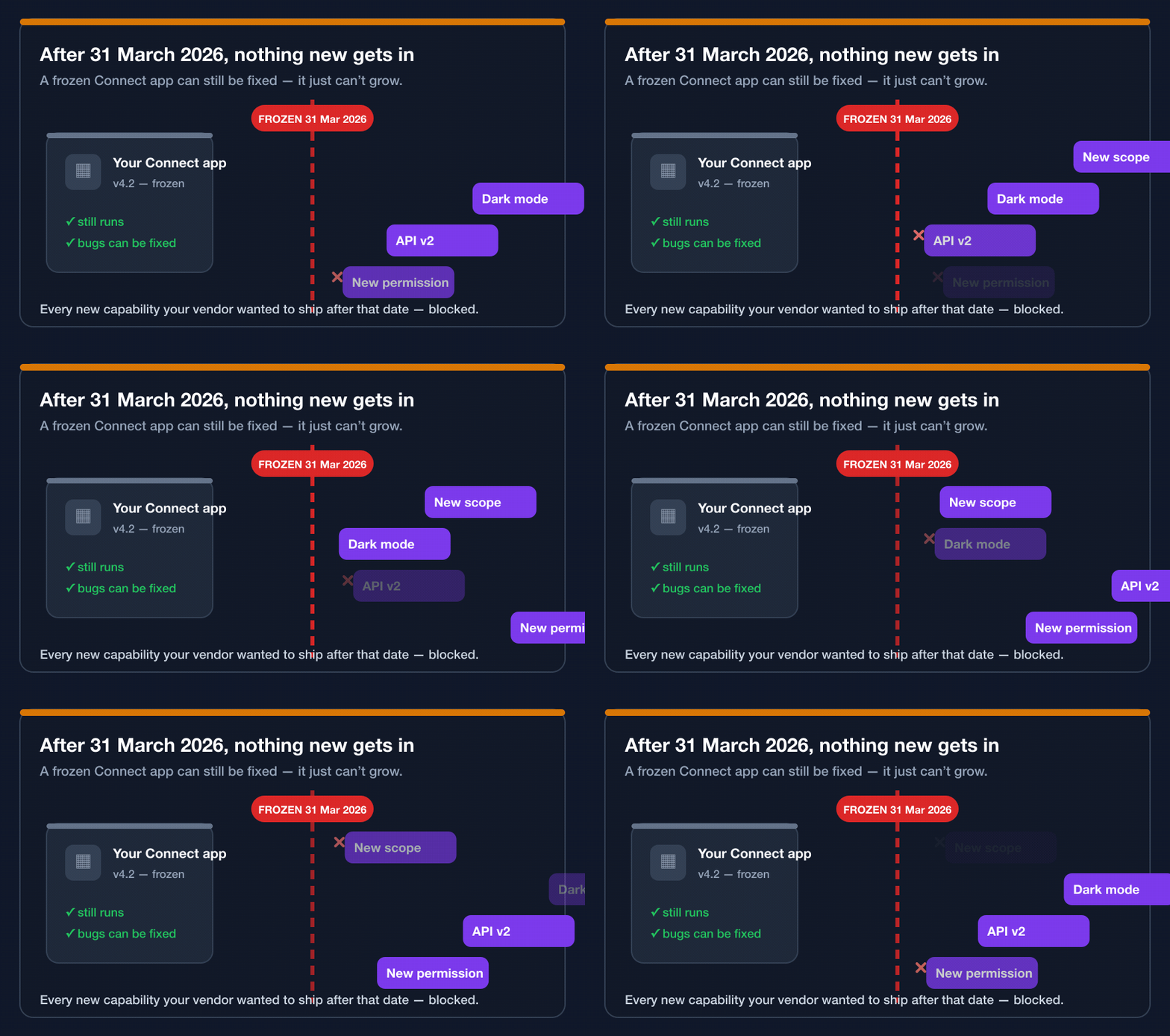
A frozen Connect app still runs and can still be patched. It just can't grow.
Frozen doesn't mean broken. The temptation is to catastrophise; the truth is more boring, and more dangerous, than that.
A frozen Connect app still runs, and its vendor can still fix what's broken in it. What they can't do after March 2026 is grow it — no new modules, no new scopes, no new surfaces. The app can still change what it already does; it just can't claim new ground.
So nothing dramatic happens. Your app keeps working, nobody gets an outage, and that's exactly why it slips past everyone.
It's not a cliff. It's a slow leak.
End of support is not a switch-off. It's gradual decay you have to go looking for.
When end of support arrives at the end of 2026, here's what Atlassian actually says happens, and I'm quoting them because the wording matters. Connect becomes, in their phrase, "use at your own risk." It stops receiving updates and security patches. Customers "won't lose access" — the apps keep running — but "some features may eventually stop working" as the platform evolves around them.
That's not a cliff. Nobody pushes your app off a ledge on 31 December. It's a slow leak. The security patches stop. The compatibility drifts. Something that worked fine gradually doesn't, and there's no single moment you can point at and say that's when it went wrong.
Of those two, the slow leak is the one that actually hurts people. A cliff you plan for. A leak you discover eighteen months later, when a security review asks who owns the unpatched app holding half your workflow data.
Forge is not another dead end
Connect is dying. Forge is not. Do not let anyone — including me — leave you with the impression that you're jumping from one sinking platform to another. Atlassian's own words are that "Forge is Atlassian's modern cloud app development platform that replaces Connect," and that it "will become Atlassian's only app development platform." They mean it.
So yes, this is the second Atlassian platform pulled out from under app owners in a few years — first Server, now Connect. And yes, "we just re-platformed, why are we doing this again" is a completely fair thing to feel. But the honest answer is that this time the destination is the one Atlassian is standardising the entire ecosystem on, not another waypoint. This isn't the treadmill. This is the last step off it.
Who actually has to move
Not everyone in this story has the same job to do. Find out which bucket each of your apps is in.
Here's where most of the panic gets misdirected, and where a little precision saves you a lot of worry.
If your app is a Marketplace app whose vendor has already shipped a Forge version, you're fine. The vendor carried it across. Atlassian's line for Marketplace apps is blunt and, in this case, true: "no action is required." Someone already did the work.
If your app is a Marketplace app that's still Connect-only, you're exposed — not doomed, exposed. There's one question to ask the vendor, and the answer tells you everything: what's your Forge date? A confident date is reassuring. A vague non-answer is your real risk signal, because the actual danger here isn't Atlassian's timeline — it's a vendor who quietly decides to abandon the app rather than rebuild it, and lets it rot on Connect while you keep paying for it.
And if you built your own app in-house on Connect — the little integration someone on your team wrote years ago that half a department now depends on — that's the one bucket where the clock is genuinely yours. Nobody is coming to migrate that. Atlassian's "no action required" does not cover the things you built yourself. That's your name on it.
What to do before the end of 2026
None of this is urgent in the way an outage is urgent. It's urgent in the worse way — the way that's easy to defer until it's expensive.
So do the boring thing now, while it's cheap. Pull the list of every app installed across your Cloud instance. Next to each one, mark whether it's running on Connect or Forge — vendors will tell you, and Atlassian exposes it. For every app still on Connect, send the vendor the one question and write down the answer, or the absence of one. And hunt down anything you built yourselves on Connect, because that's the work only you can schedule, and it's the work that will still be sitting there, unowned, when the end of 2026 arrives.
That's an afternoon of work. It's the cheapest afternoon you'll spend on this whole thing.
So
Your data migration was the hard part, and if you've done it, the hard part is behind you. This one's small and quiet, and almost nobody makes it until something breaks — which is exactly why the handful who handle it in 2026 will look like they saw something coming.
They didn't see anything you can't. They just looked at the deadline nobody's watching.
So here's the only question that matters this time: do you actually know which of your Cloud apps are running on Connect? I didn't, until I went looking. And you can't plan for a deadline you don't know you have.